
The advocates of the conventional model of second millennium BCE Middle Eastern chronology have argued for the accuracy of their so-called “historical chronology” so vociferously that they have sometimes even convinced scientists to turn their backs on their own correctly interpreted datasets and adopt the erroneous conventional viewpoint. What is the root cause of these mistakes? They have failed to use the two most crucial reality checks for a chronological model: astronomical data points and other verifying astronomical data points.
The “scholarly consensus” is that the earliest unambiguous and reliable astronomical record of the ancient Middle East is the solar eclipse recorded in the 10th year of Assyrian King Aššur-dan III, assigned to 763 BCE. This lack of celestial data means that, when considering ancient Middle Eastern chronology back to 2000 BCE, 1237 years (2000-763) of the timelines lack astronomical verification.
So, then, why do they think their models are correct? Part of their convention (tradition) is the credulous belief that the Assyrian King List (AKL) is complete (without missing years) from Aššur-dan III’s reign back to the Assyrian king of the Amarna Period, Aššur-uballiṭ I, and they assign the start of his reign to circa 1353 BCE. However, since they also believe that no reliable astronomical records exist from this nearly six-century interval, there is no verification that the AKL is complete.
Ah, but there are Egyptian Sothic dates from the second millennium BCE! Do they not verify the completeness of the AKL? The evidence is abundant that the Egyptians had multiple calendar systems, invalidating their Sothic dates. Therefore, no verification exists. What about the Egyptian radiocarbon dates? They come in two divergent sets (from Upper and Lower Egypt), with very different chronological implications. Once again, no verification exists.
In contrast, The Six Pillars of Second Millennium BCE Middle Eastern Chronology (unabridged) contains over 160 astronomical links for the period of study, spanning seven centuries of Assyrian and Babylonian timelines and three centuries of Egyptian chronology. The admitted disadvantage of these various records and allusions is that relatively few contain enough details to be unambiguous on their own. The advantage of such a large number is that they verify each other.
The 17 solar eclipses in The Six Pillars illustrate the ambiguities. Only five of the seventeen explicitly stated the current king’s regnal year, although related records strongly imply exact years for the seven from Egypt. Many of these seventeen records and allusions provided no other details about the observation other than that a solar eclipse had occurred. (Some are “allusions” because they did not specifically state that solar eclipses had occurred, but indicated this fact through traditional symbology.) Still, two of them, including an Egyptian record, designated or implied the month of the event, and a Hittite observation record suggested a season. Seven included details of other simultaneous astronomical configurations, including the positions of planets.
The inclusion of other details such as the regnal year, the month of the event, and planetary positions makes these records and allusions far less ambiguous. Babylonian kudurrus (boundary stones) recorded solar eclipses with an eclipse symbol, and some indicated the constellations associated with the planets at the time of the eclipse. It is this combination of celestial events with differing cycle lengths that provides verifiable accuracy to these depictions.
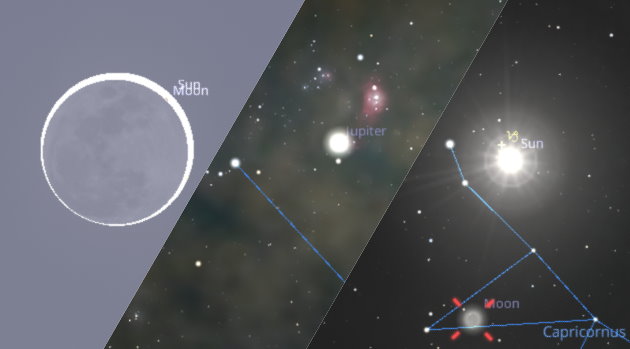
Even if they are not in the same record, king-list-based intervals can connect observations with different cycles. For example, imagine that a record stated that a nearly total solar eclipse occurred in the sixth month, and another report recorded that, ten years later, Jupiter was in the Milky Way. Five years later, a third report recorded a solstice on the 28th day of the 10th lunar month. (See illustration above.) Solar eclipses, Jupiter cycles, and solstices recorded with lunar dates all have cycles of differing lengths. This combination of details, including known intervals between them, can change three ambiguous events into a composite that is rare enough to have occurred only once in several centuries.
The solar eclipse record from the 10th year of Aššur-dan III included no other details besides the month. In contrast, The Six Pillars’ 160-plus astronomical dates include many types of celestial events with differing cycles and known intervals, and several individual records are very unambiguous and detailed. These facts make The Six Pillars’ second-millennium BCE model even more reliable than conventional first-millennium timelines.