
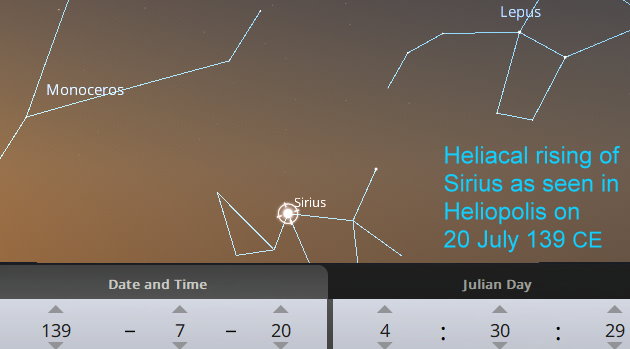
“Sothic dates” are anciently recorded observations of the heliacal rising of the star Sirius. They are critical evidence in studying ancient Egyptian chronology, but not for the reasons most researchers believe.
Egyptologists, archaeologists, historians, and students of Egyptian history correctly understand that the ancient Egyptians had a calendar system with a 365-day year and no leap years. Consequently, the annual missing one-quarter day summed to a full day after four years, shifting their calendar toward the start of the tropical year (one day per four years). Sirius rose heliacally each year in July. Thus, if two Sothic date records were on I prt 1 (fifth month, first day) and II prt 1 (sixth month, first day), approximately 120 years would have separated these observations. (30 days difference x 4 years/day) A basic assumption is that the observers must have been at the same latitude because a one-degree change would result in a one-day shift in the observation date.
These premises are essentially correct. Their calendar consisted of 12 months, each with 30 days, and an extra five days added at the end of the year. Although the Egyptians used this same basic structure for their calendars, they had many regional variations with diverse orientations to the tropical year. Moreover, they sometimes had calendar reforms. Consequently, I prt 1 in one calendar system might equal I šmw 23 (ninth month, twenty-third day) in another.
Many conventional chronologists do not acknowledge that the Egyptians had regional calendar systems and reforms. Therefore, they believe they can use the constant drifting of Sothic dates to determine approximately absolute dates of early Sothic observations by calculating backward from late Egyptian observation dates. For example, Egyptian records include the heliacal rising of Sirius on I 3ḫt 1 (New Year’s Day) in 139 CE. A well-known early Sothic date was from the ninth year of the Eighteenth Dynasty Pharaoh Amenhotep I on III šmw 9. This date is 56 days before I 3ḫt 1, and another cycle of 365 days (a Grand Sothic Cycle) passed before the date in 139 CE. Therefore, the total difference would be 421 days. Ignoring the latitude differences and other adjustments, the difference in years is approximately 1684 years (421 x 4). This method would place that observation from the reign of Amenhotep I in approximately 1546 BCE. With changes required to adjust for latitude and viewing conditions, the actual date would be around 1521 or perhaps a few years later.
The reason this method is invalid is that these two Sothic records involved two calendar systems, the Theban and Menophres. The Menophres New Year in 139 CE is precisely datable with astronomers’ records of that era to 20 July. The Theban system’s Sothic date is also precisely datable but requires near-term astronomical records. With such an absolute anchor for the calendar system, Sothic dates identify the orientation of the drifting Egyptian calendar to the tropical year.
A previous post, “Common Sense and the Dogma of a Single Egyptian Calendar System,” discussed reasons to conclude that the ancient Egyptians had more than one solar calendar system. Closely examining that article’s list of Sothic dates reveals a minimum of eight distinct calendar systems, and others existed.
Included in that list is the Twelfth Dynasty Sothic date IV prt 16 during the reign of Senusret III. Trying to directly link this Sothic observation with the Eighteenth Dynasty record or the one in 139 CE is not a legitimate method. A Twelfth Dynasty astronomer used a third distinct calendar, the Illahun system, to preserve that Sothic date. So, how is it possible to reliably date this event? If an unambiguous astronomical record with a Twelfth Dynasty king’s name and regnal year were available, we could use it to anchor this calendar system. Alternatively, if the interval between the Twelfth and Eighteenth Dynasties were determinable through other means, we could use that technique to approximately anchor the earlier dynasty and fine-tune it with lunar dates. As it turns out, both methods are possible, and they are perfectly compatible with each other.
Thus, Sothic dates are a necessary part of Egyptian chronological research. However, we cannot assume those ancient records used the same calendar system. The Nineteenth Dynasty and earlier Sothic dates require reliable near-term astronomical anchors.
One comment