
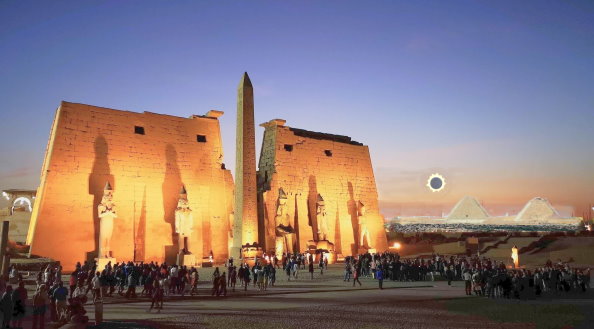
Solar eclipses were notable events to ancient Egyptian monarchs because they viewed them as messages from the sun god. Nevertheless, ancient records only hinted at these events using a special glyph meaning “horizon” 𓈌 Ꜣḫt. This symbol doubled as indicating a solar eclipse, presumably because the sun emerged from behind the moon as it did from behind the horizon each morning. Another cryptic reference to a solar eclipse was illustrating Khepri, a god of the rising sun, as a dung beetle with wings.
Most ancient Egyptian evidence that eclipses had occurred were allusions rather than references. When Egyptian monarchs personally witnessed high-magnitude solar eclipses, they often had pre-Year 30 heb sed (Jubilee) celebrations. Another way to commemorate the occasion was to commission obelisks, usually in pairs.
These references and allusions to solar eclipses are crucial clues in reconstructing ancient Egyptian chronology. Egyptian king lists that include reign lengths are usually incomplete and damaged. These sources are sometimes helpful, but Egyptologists often must rely on the highest regnal year found in contemporaneous records.
Lunar dates and related Sothic dates can help determine the accuracy of regnal period estimates. After 25 Egyptian years, full or dark moon dates usually repeat precisely with identical calendar dates. If the chronological model is already close to precision and enough lunar references are available, comparing the lunar cycle to these references can help the researcher accurately determine if reign length figures derived from artifacts and king lists account for all the years of individual kings and the entire dynasty. However, if the lunar data is insufficient, 11 and 14 Egyptian year intervals give false positives with only a one-day discrepancy. Moreover, lunar data from some periods is rare. Consequently, the relative chronology scholars have estimated is often severely flawed over multiple dynasties. For this reason and others, their dating of the Egyptian Eighteenth Dynasty is over a century too late.
Solar eclipse references and allusions can partially compensate for these deficiencies. However, they have some drawbacks: 1) Obelisks and related documents only rarely refer to specific regnal years, making it challenging to link obelisk pairs to specific eclipses. 2) The same is true of pre-Year 30 heb sed records. 3) The king might have observed a high-magnitude eclipse while on a military campaign in a region outside Egypt’s borders. 4) Some eclipse paths missed Egypt but were still high magnitude in the north near the Mediterranean coast or just south of Elephantine. 5) The eclipse might have been high magnitude in the north but not in the south or vice versa. So, it is essential to know the location of the capital where the observation likely occurred.
The advantages of this method are: 1) Some obelisks and pre-Year 30 Jubilees have related regnal year records. 2) Every obelisk (or pair) resulted from an eclipse observation, though a couple of them were consequent to a crown prince’s observation shortly before the death of his predecessor. 3) Pre-Year 30 heb seds always alluded to high-magnitude solar eclipses.
Solar eclipses of high magnitude (of 0.80 or higher) frequently come in clusters of three to five over a four- to sixteen-year interval with much larger gaps between them. Twentieth Dynasty kings Ramesses III through VI all had allusions to solar eclipses during their reigns, with no such evidence from the tenures of Ramesses VII and VIII. Since the sum of the regnal periods of Ramesses IV through VI was only about two decades, a cluster of at least three high-magnitude solar eclipses must have occurred during this interval, information essential for reconstructing that dynasty’s absolute timeframe.
Records from one of the later pharaohs had two regnal-year dated solar eclipse allusions, which makes it possible to anchor his regnal period astronomically. This clue helps assess the interim between these periods, determine when his dynasty began, and estimate the timing of later dynasties and their kings.
A dated solar eclipse allusion from a Twelfth Dynasty king is essential for astronomically anchoring that ruling family’s relative timeline.
Obelisks associated with Egyptian sun temples and heb-sed records are vital in establishing the chronologies of the Fourth and Fifth Dynasties.
Thus, allusions to solar eclipse observations are crucial clues in rebuilding the chronology of ancient Egypt from the Old Kingdom through the Third Intermediate Period.