
Scholars of ancient history generally recognize that contemporaneous records of ancient astronomical observations can potentially yield precisely accurate dates for the years in which the observations were recorded. Nevertheless, a previous post, “Why an Astronomical Chronological Model Can Be Irrefutable,” pointed out some common flaws in astronomical dating. Two related aspects of this problem are: 1) Scholars reject many actual astronomical records and allusions that provide important clues about ancient chronology. 2) They accept many records that are genuinely ancient but not based on observations.
Besides altering genuine observation records to fit the conventional timeline, traditionalists reject some genuine astronomical records, such as kudurru reliefs, because they have not cracked the method the ancient Babylonians used to compose them. The forthcoming book, The Six Pillars, explains that method and the symbols they used.
Two other sources of ancient celestial observations are 1) Egyptian obelisks and 2) Mesopotamian festival records with links to equinoxes and solstices. In both cases, these are allusions rather than direct references to cosmic events. Egyptian kings commissioned obelisks after personally witnessing a high-magnitude solar eclipse. In most cases, they are undatable to specific regnal years, but the rare exceptions are valuable for chronological purposes. Similarly, records of equinox and solstice festivals do not specifically mention their links with these quarterly events. Nevertheless, since the ancient Mesopotamians dated them using lunar calendars, the annually changing day of the month helps to identify the precise year.
The second problem mentioned above is a serious one. The current conventional view stems from accepting astronomical records that are not based on direct observations. We can easily illustrate this fault with modern astronomical software. The software uses mathematics to calculate and display celestial events that were centuries or millennia ago. Just because a person finds an event in an astronomy program that matches their chronological model does not mean it represents an actual observation or the correct date of a recorded event. Similarly, the Seleucid Era Babylonian astrologers employed mathematical astronomy to identify astronomical configurations that corresponded to historical events within their conventional chronological framework. Some of their historical dates were correct, but others were not. In either case, the calculated celestial events were not based on actual observations, no matter how accurate their mathematics were. Modern scholars often assume that Seleucid Era “astronomical records” were merely late copies of events recorded centuries earlier. In a few cases, they were. In many cases, they were not.
This problem is readily apparent in the solar eclipses of the fourth century BCE. The Seleucid Era astrologers could calculate when past lunar eclipses occurred because people could observe them almost anywhere on the dark side of Earth. Their calculations of solar eclipses were less precise because they could not determine the eclipse paths and where they were visible. The best they could do was to specify dates when solar eclipses might have occurred somewhere on the planet. Thus, their records of solar eclipses from the fourth century BCE are often erroneous. Consequently, the basis of many of their so-called “astronomical diaries” of that era was mathematical astronomy, not observation records.
Several centuries later, Claudius Ptolemy inherited the partially defective chronological model of the Babylonians of the Seleucid Era. Despite the well-known fact that Ptolemy often took shortcuts with his “observations,” many people consider the validity of his work unquestionable. Yet, he based many of the lunar eclipses in his Canon on mathematical astronomy rather than observation inscriptions. Independent records can confirm that only one out of ten of his Babylonian lunar eclipses (from 721 to 382 BCE) came from an ancient source, and some are entirely wrong.
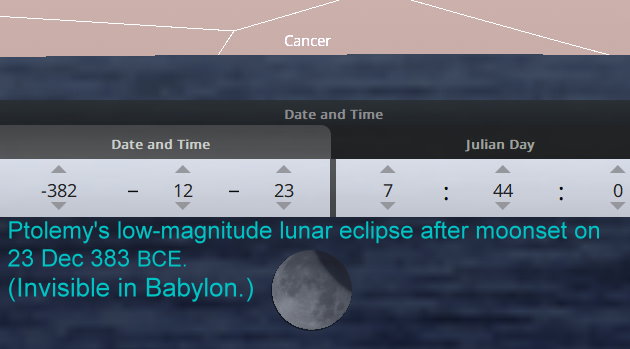
The Babylonians considered sequences of four or three consecutive high-magnitude lunar eclipses, separated by six months, to be especially auspicious, and they often recorded them. Ptolemy wrote that three eclipses were on 23 Dec 383, 18 Jun 382, and 12 Dec 382 BCE. The actual dates of the total eclipse ‘triplet’ were about 354 days later (but the third was calculated and not visible in Babylon). The conventional timeline that Ptolemy apparently used shifted the related historical events a year too early, and he mistakenly calculated the concurrent lunar eclipses accordingly.
Clearly, accurate and detailed records of astronomical events are crucial for historical chronology, but caution is warranted to avoid some common mistakes in their use.
One comment