
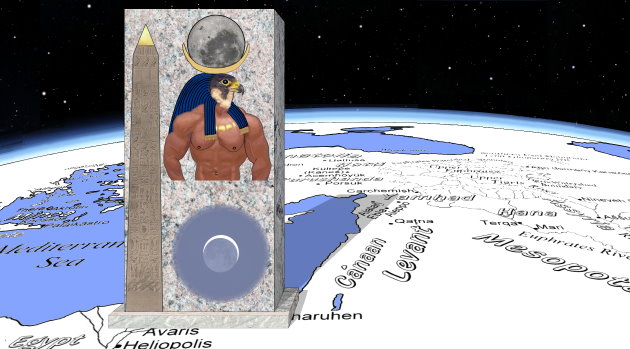
Several types of astronomical data are essential for Egyptian chronology. These include records of the heliacal rising of Sirius (Sothic dates), lunar day records, and specific records of and allusions to solar eclipses.
When we discuss “astronomical chronology” for the ancient Middle East, most researchers and historians recognize that this topic is vital for establishing the Egyptian dynasties’ timelines. However, conventional chronologists mistakenly believe they have established an approximately accurate Egyptian New Kingdom chronological history through an Amarna Period synchronism with Assyria, and the Assyrian King List (AKL) counted forward to astronomical links in the eighth and seventh centuries BCE. Although those Amarna Period contemporary kingships are valid, this approach is flawed because the AKL has gaps between the Amarna Period and the “Assyrian eclipse.”
The correct absolute timeframe for the Amarna Period is determinable, given the Assyrian and Babylonian king list data and multiple second-millennium-BCE astronomical links for both kingdoms. Moreover, a solar eclipse in a Hittite record has two chronological links to the Egyptian Eighteenth Dynasty, and it adds additional evidence of the accuracy of the Amarna Period’s timeline anchor. Thus, astronomical records are vital for Egyptian chronology, but these inscriptions are not from Egyptian sources. Nevertheless, astronomical records and allusions from Egyptian sources are also crucial, harmonizing with these other lines of evidence.

The Egyptian solar calendar had only 365 days, whereas Earth’s orbit around the sun lasts almost a quarter of a day longer. Consequently, the Egyptian calendar drifted one day per four years relative to the tropical year. A specific Egyptian calendar date, such as the first day of the year, I Ꜣḫt 1, could occur in any season. The calendar day record of a Sothic date in July indicated the contemporaneous orientation of the drifting Egyptian calendar with the tropical year. A Sothic date’s record of a king’s regnal year made it possible to extrapolate that orientation to the entire dynasty.
Anciently recorded lunar dates are also crucial. Unfortunately, this is another primary source of error in the conventional chronology. During the Ptolemaic Dynasty, the Egyptians inverted their orientation of the moon’s cycle when they adopted the Macedonian lunar calendar. In earlier periods, they viewed the start of the moon’s cycle as the day of the astronomical full moon (psdntjw, Lunar Day 1).
Full moon days were of primary importance to the ancient Egyptians because many festivals began on Lunar Day 1 or 2. Nevertheless, they viewed both full and dark moon days as crucial in funerary contexts. Moreover, they had a minority of their celebrations on the dark moon or first lunar crescent days, and they delayed the coronation of a new king after the death of his predecessor until the following dark moon period. If the coronation ceremonies were for the start of a coregency, it was on a full moon day. They also often dated official government stelae that did not concern military events to full moons.
Egyptian king list data is incomplete, and the highest regnal years recorded in monuments and inscriptions often do not represent the final years of Egyptian pharaohs. For this reason, lunar dates are crucial in identifying missing years.
A final category of Egyptian astronomical clues is allusions to solar eclipses. Solar deities were critical to pharaohs because they claimed to be ‘sons of the sun god.’ They believed (or propagated the belief that) a dead pharaoh became united with the sun god in the afterlife. Thus, a living king could say that a solar deity was his father. Consequently, they viewed high-magnitude solar eclipses as extraordinary messages indicating the sun god’s approval of the current pharaoh and foreshadowing his eternal destiny.
An Egyptian monarch celebrated a notable solar eclipse in three ways: 1) he inscribed a stela stating that the sun god had expressed his approval of the king; 2) he had an irregular heb sed festival (Jubilee) before the usual king’s Year 30 celebration; or 3) he erected obelisks (or added inscriptions to existing spires). (See an article by the person who discovered #2 and #3, Aymen Ibrahem. These theories are correct, although he erroneously tried to apply them to the conventional timeline.)
These various lines of astronomical evidence, combined with king list data and dated inscriptions, make it possible to deduce absolute timelines for several Egyptian dynasties.
One comment