
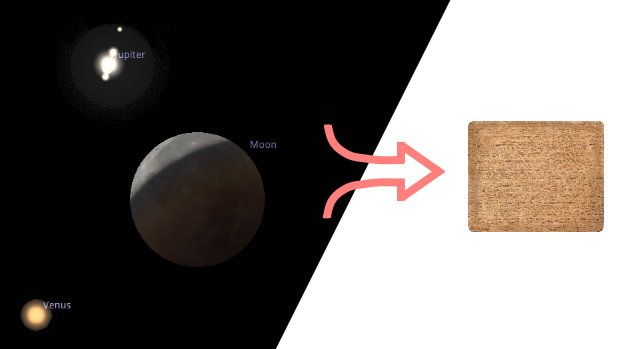
Ideally, a chronological model should have abundant historical data to support it. For the Middle Eastern timelines in the second millennium BCE, king list and regnal period data are crucial for determining the relative chronology of individual kingdoms and empires. International synchronisms help to align these timelines with one another. Even if all the assigned reign-length figures in such a reconstructed relative timeline are accurate, that reconstruction needs one or more astronomical anchors to identify that timeline with a specific Julian calendar timeframe.
The Wikipedia article “Astronomical Chronology” discusses this important topic. It quotes one of the best scholars of the history of astronomy, Professor John Steele: “Astronomical dating can be a powerful tool for establishing absolute chronologies, but… it can easily produce precise and impressive looking results based on invalid assumptions – results so precise and impressive they may not be questioned by scholars in other fields.” Then, this article lists three questions that Prof. Steele proposed to determine if an ancient celestial record is genuine and reliable.
Prof. Steele’s comments and questions imply some problems with such records: 1) The idea that an ambiguous inscription has a possible allusion to an astronomical event might not be a valid interpretation. 2) Even if it does, the source might not be reliable. 3) Even genuine celestial records might not lead to unambiguous dates.
The first of these points is a minor problem if a document’s record of a celestial observation is reasonably clear because inscriptions that seemingly record cosmic events usually are what they appear to be. In fact, many researchers have rejected genuine astronomical records because the observations were incompatible with the conventional chronological model. Nevertheless, some proposed allusions to astronomical observations in cryptic language are dubious.
The second problem is weightier. Ancient peoples were also interested in reconstructing their historical chronology, but some of their timeline models were erroneous. Because such chronological models are genuinely ancient, researchers sometimes credulously accept them as authentic history. Those ancient compilers were just as human and prone to error as people are today, which means their chronological reconstructions were sometimes partially or entirely mistaken. Unfortunately, in a few cases, the composers of historical timeline models were intentionally deceptive! Yet, modern historians accept their models as factual.
The final problem is the worst. Most genuine astronomical records from the ancient past are ambiguous because of insufficient details and the cyclical nature of solar and lunar eclipses and planetary events. Furthermore, explicitly dated observation records are rare; most do not contain the regnal year of the event, and they frequently do not even name the reigning king. Consequently, researchers tend to assign such celestial observations to the wrong dates to conform to the conventional model or their slightly variant interpretations of traditional timelines.
How can we avoid these pitfalls? A few ancient documents record rare astronomical events, and the observers dated them to specific regnal years. In some cases, the historical context of the observation makes it datable to an exact year within a king’s tenure. Moreover, when the number of years between astronomical events of differing cyclical lengths is determinable, the combination is far less ambiguous than the individual records. With the addition of still others, a unique pattern emerges in that region’s history. International synchronisms expand that pattern to the celestial records of other kingdoms. With enough interim, synchronistic, and celestial links, all ambiguity disappears, making the model irrefutable.
The Six Pillars, Volume I of The Astronomical Chronology, uses this approach. It includes dozens of astronomical records and allusions to celestial events. That model astronomically anchors the second millennium BCE Assyrian and Babylonian timelines independently of each other several centuries apart. Yet, both timelines identify the same Julian calendar years for conflicts between their nations. Furthermore, their synchronous links with Egypt relate the Mesopotamian absolute timelines to that nation’s unique pattern of Sothic and lunar dates and solar eclipse allusions. This type of harmony between these three kingdoms’ celestial records would be impossible if the model were erroneous.

Your article helped me a lot, is there any more related content? Thanks!
Thank you for your comment! Please see the Home Page, read the content, and study the related chart. Another factor that can assist in making a chronological model irrefutable is when independent or semi-independent timelines identify the same absolute (Julian calendar) date for the same event. For example, in The Six Pillars, astronomical events anchor the Assyrian timeline in the late 1800s and early 1700s BCE, and other celestial events independently anchor the Babylonian timeline in the 1200s and 1100s BCE. Yet both timelines identify the exact years of two wars between their kingdoms, and they agree precisely! This agreement is strong evidence that both assigned timeframes are accurate.