
Several lines of evidence argue that they were. The expression “contemporary monarchs” means they simultaneously ruled their respective countries. Since both rulers reigned for approximately half a century, such an overlap could easily have occurred. However, what evidence verifies they were contemporaries?
Khyan was a Fifteenth Dynasty Hyksos ruler. Many writers have portrayed the Hyksos as aggressive Asian invaders. Although that was true of Khyan’s successor, Apepi (or Apophis), the opposite was true during the reign of Khyan. Egypt needed foreign products, and it had resources that other peoples needed. Consequently, efficient international trade benefited all involved parties, and Khyan expanded this system to new heights.
During the first decades of Hammurabi’s reign, he and his ally, Assyrian King Šamši-Adad I, fought to restore lucrative trade routes from and through their kingdoms to western markets in Anatolia, the Levant, and even Egypt. A lion statue with Khyan’s cartouche, found in Baghdad, bears witness to that vast trade network, and this Egyptian pharaoh likely gifted that item to Hammurabi.
As previously discussed, the Middle Chronology correctly places the ruling period of Hammurabi from 1792 through 1750 BCE. The triple astronomical anchoring of Šamši-Adad I reign verifies this timeframe. Did Khyan’s regnal period overlap Hammurabi’s?
The fragmentary Turin King List shows that the Fifteenth Dynasty lasted at least two centuries, with six rulers, and the final pharaoh was Khamudy. The garbled and repeatedly transcribed versions of Manetho also show that the Hyksos dynasty lasted over 200 years and lists six kings without Khamudy. Archaeological evidence and scarab styles show that the final four kings (of seven) were Khyan, his son Yanassi, Apepi, and Khamudy. (The first three were Salatis, Bnon, and Apachnan.) The variant copies of Manetho agree that Apepi had a long reign of 61 years.
How can we reasonably explain the discrepancy between the Turin King List and Manetho in the number of kings? Many long-reigning monarchs shared their kingships in their declining years by making the crown prince a full-fledged coregent. The similarities between two regnal periods in Manethoan copies just before Apophis seemingly verify this scenario. They state that one monarch ruled 50 years, one month, and the next 49 years, two months. These figures are likely from Khyan’s sole rule and inclusive of his coregency. Apparently, Yanessi shared his father’s authority during the final 11 months of his life. Soon after Khyan’s death, word of his demise reached Apepi in Canaan, who must have been a city-state king or perhaps a brigand leader. He and his forces soon conquered Avaris, the Hyksos capital, and executed Yanessi after the latter had a brief sole reign of only a week or two. Consequently, the Turin King List did not include him in the six kings.
Scientific data and the internal chronology of Egypt demonstrate the fall of the Hyksos Dynasty was just after Thera’s eruption in September 1650 BCE, and that was Khamudy’s Year 11. These details place the start of Apepi’s 61-year reign between 1722 and 1720 BCE. Counting back an additional 51 years for the reigns of Khyan and Yanessi would place Khyan’s accession in approximately 1771 BCE, just about halfway through Hammurabi’s 43-year tenure.
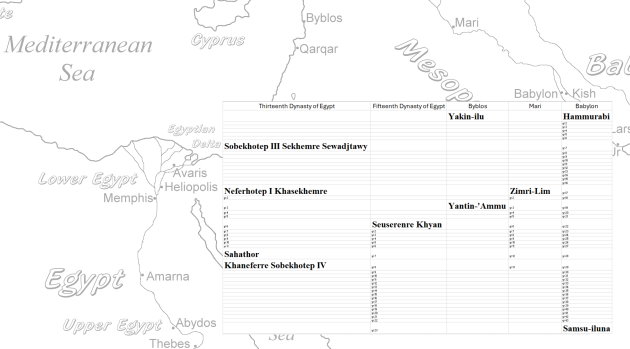
Archaeologist William F. Albright provided circumstantial confirmation of this scenario in 1945. Zimri-Lim, king of Mari, was a contemporary of Hammurabi. An artifact shows his contemporaneity with Yantin-‘Ammu of the coastal Levantine city of Byblos. Objects from the latter town show that he and his father, Yakin-ilu, were contemporaries of Khasekhemre Neferhotep I, identified as a Thirteenth Dynasty ruler. This pharaoh’s predecessor was Sobekhotep III, and after his rule with his coregent, Sahathor, his successor was Khaneferre Sobekhotep IV.
Contemporaneous seals found in Edfu demonstrate with reasonable certainty that Sobekhotep IV and Khyan were contemporaries. Moreover, seals and ceramics in Tell el-Dab’a from Khyan’s tenure have temporal links to those of Sobekhotep III and Neferhotep I. Thus, Khyan’s long reign encompassed or was temporally near all these nomarchs’ ruling periods.
Despite traditions to the contrary, these many chronological links between Khyan and the Thirteenth Dynasty nomarchs and their links, in turn, with Byblos and Mari, provide convincing evidence that Khyan and Hammurabi were contemporary kings.