
Once The Six Pillars is published, Egyptologists will face a challenging problem. How will they reassess the chronology of the Twelfth Dynasty and the Second Intermediate Period (SIP)? Will they use common sense and critical and lateral thinking to derive a better understanding, or will they continue to insist their disproven traditions are correct? Of course, it will take time for The Six Pillars’ evidence to sink in. However, its comprehensive examination of the Eighteenth Dynasty chronology proves beyond doubt that it began over a century earlier than the conventional model, i.e., it started in the first half of the seventeenth century BCE.
The primary basis for the conventional chronology’s placement of the Twelfth and Eighteenth Dynasties are Sothic dates. Since the Egyptian calendar (without a leap-year day) drifted one day per four years, they assumed that the difference between those dynasties’ IV prt 16 and III šmw 9 Sothic dates would place these observations around 332 years apart. (83 days difference in the calendar X 4 years/day) With that (inaccurate) method, they believe that the interval between those two dynasties was approximately 225 years.
A previous post has shown that Sothic dates are crucial chronological clues if those records’ calendar systems have astronomical anchors. Still, the basis for the Eighteenth Dynasty’s Sothic dates was the Theban calendar, not the later Menophres calendar, which the Egyptian kings adopted in the final part of the Nineteenth Dynasty. Moreover, no evidence exists that the Twelfth Dynasty’s officials primarily used the Theban or Menophres calendar systems. Instead, they used a regional one, which we can call the “El Lahun calendar system.” Without a Sothic date link to the Eighteenth Dynasty, how can researchers determine an accurate Julian calendar timeframe for the Twelfth Dynasty?
Radiocarbon dates from Lower Egypt tend to overstate ages, but they can at least provide a very crude estimate. Even taken at face value, the Twelfth Dynasty could not have begun earlier than around 2000 BCE. Using that figure, the last known ruler of that dynasty, Queen Sobekneferu, must have died around 1800 BCE. Even with those excessive ages for the Middle Kingdom, it would be problematic to fit all the SIP dynasties into the interval between the Twelfth and Eighteenth Dynasties. With the conventional minimalist understanding of overlapping dynasties, can the entire SIP have begun and ended in less than a century and a half?
An accurate assessment of the Fifteenth Dynasty chronology further compounds this situation. Manetho’s copyists assigned a minimum of 259 years to that dynasty. Their transcriptions were somewhat garbled, but we can realistically conclude that the Hyksos dynasty began at least two centuries before the Thera eruption in 1650 BCE since it contributed to the termination of the Fifteenth Dynasty in the Delta.
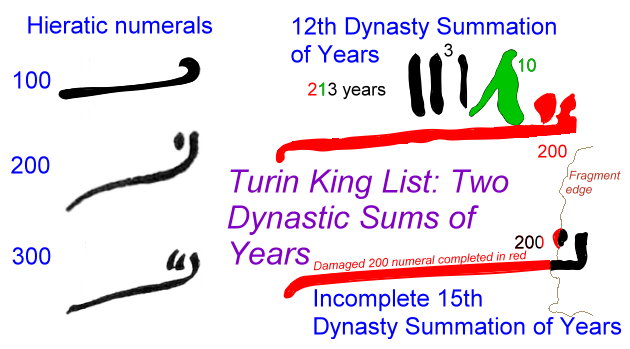
Around nine decades ago, one researcher stated that the Turin King List (TKL) assigned 108 years to this dynasty. However, he had apparently derived this figure by dividing the supposed interval between the Twelfth and Eighteenth Dynasties in half. The incomplete TKL fragment (Column 10.29) with the Fifteenth Dynasty’s summation, compared with hieratic numbers, indicates at least two centuries, as illustrated above. Some researchers have claimed that the incomplete dot next to the “100” numeral was perhaps part of a 40, 60, or 80 number. Nevertheless, comparing it with the TKL Twelfth Dynasty summation (Column 7.3) shows that the copyist enlarged the tens and ones units and allowed generous spacing between them and the hundreds unit. Therefore, “200” is almost certainly correct. Thus, the Fifteenth Dynasty must have begun in the early nineteenth century and overlapped the other SIP dynasties and even the Twelfth Dynasty.
Since the mid-1800s CE, critics of the conventional chronology have been pointing out that there is substantial proof that all the SIP dynasties overlapped with each other and the Twelfth Dynasty. Not all their arguments were valid, but many were.
With the upcoming publishing of The Six Pillars, will scholars finally begin to follow factual evidence rather than traditions to establish a correct understanding of the Twelfth Dynasty and SIP chronology? Undoubtedly, some researchers will display common sense and critical and lateral thinking and begin elucidating that elusive timeline.
4 comments