
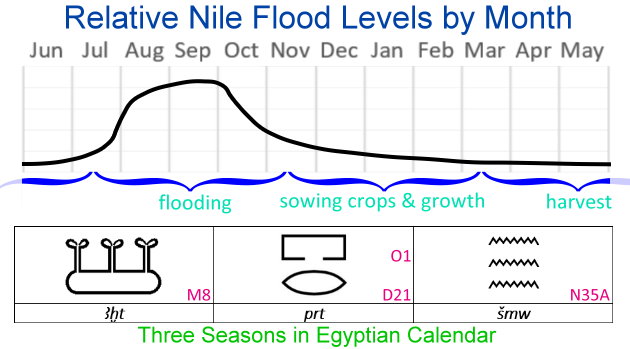
During the First Dynasty, a king or official realized that the solar year in Egypt had three natural divisions or seasons based on the Nile River and their agricultural cycle. The drawing above depicts the average Nile River levels before the construction of the Aswan Dams (dated with the current Gregorian Calendar). As illustrated, those three seasons were 1) flooding, 2) planting and growth of crops, and 3) harvest. Below are the three hieroglyphs the ancient Egyptians used to identify those three seasons.
Their calendar had only 365 days without a leap year, so their seasons drifted relative to the solar (or tropical) year. Consequently, over about fourteen centuries, each calendar season aligned with all three agricultural seasons. For this reason, history does not identify the original season associated with each sign.
If you did not understand their written language but knew that most glyphs were originally pictographs (pictures of what they represented), which seasons would you guess those symbols represented? This is not a trick question; common sense should lead to the answers.
The first glyph, Ꜣḫt (often pronounced Akhet), looks like sprouting plants. Therefore, a common-sense guess would be that it represents the season of planting and growing crops.
The second one is simple but not so obvious. However, if you look up the meanings in a hieroglyphics dictionary of the two glyphs that constitute prt (often pronounced Peret), you will find they mean “building” (or “house”) and “mouth.” Since “mouth” could represent food, this combination might mean a building for storing food or bringing fresh produce into the home for consumption. Thus, a common-sense conclusion is that prt represents the harvest season.
The third glyph, šmw (often pronounced Shemu), looks like water flowing. Other ancient pictographic languages, such as Chinese, had similar depictions of water, flooding, or rivers. For example, the Chinese character 巛 (or 川), pronounced chuān, means “river.” A single wavy line (N35) would indicate a stream of water, whereas a tripling of it (N35A) would probably indicate the yearly inundation. Thus, a common-sense guess would be that šmw is the annual flooding season.
Despite these tentative but common-sense guesses, most experts designate Ꜣḫt as the Inundation or Flood season, prt as the season of Emergence of crops (or Winter), and šmw as the season of the Harvest. (What?!?!) If their understanding is correct, an Egyptian dictionary should use these glyphs in related words. If our common-sense solutions are correctly understood, we should be able to find them used in associated definitions.
Nevertheless, the ancient Egyptian hieroglyphic language was very complex and often had many ways to represent the same idea. Moreover, it “combined logographic, syllabic, and alphabetic elements.” In other words, an individual symbol could be pictographic, ideographic, or represent one or more sounds, etc. Therefore, in most words, their uses would not be directly related to their pictographic meanings. (Dictionaries represent the individual glyphs as “Gardener signs;” the corresponding codes for Ꜣḫt, prt, and šmw are M8, O1 – D21, and N35A, respectively.)
When searching for N35A (šmw) in the searchable Mark Vygus Dictionary, this triple-ripple character appears in 106 definitions. More than 60 include “flood,” “flooding,” “flood waters,” etc. Other uses involve “canal,” “water,” and “pool.” Moreover, many words meaning the Nile River or its waters include this sign. In contrast, M8 (Ꜣḫt) is in only one word for “flood,” apart from the season definition. Thus, we can reasonably conclude that the original meaning of the season name šmw was ‘the high flood period.’
Similarly, the upper part of prt, O1, is part of many words that mean “storehouse” or “granary.” The combination O1 – D21 often appears in words meaning ‘to go forth, to emerge, to escape,’ likely drawn from the idea of harvested crops leaving the fields.
The original meaning of M8 (Ꜣḫt) was likely plants growing on irrigated soil, so some words with this glyph relate to crops and others to water.
Therefore, the dictionary uses of these glyphs support common-sense interpretations better than conventional ones in two of three cases, and all three hieroglyphs represent the seasons their pictographs imply.
3 comments