
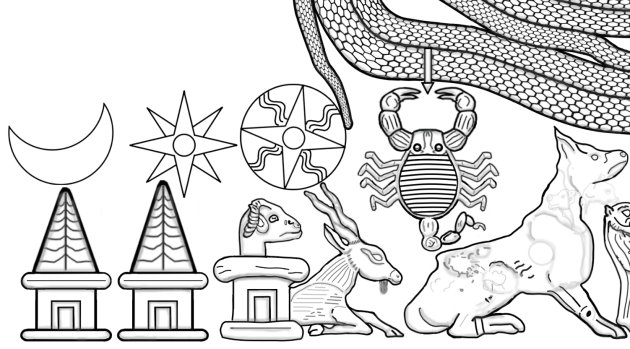
The incomplete illustration above contains some prominent astronomical symbols. It includes a scorpion, a representation of Scorpius constellation. The picture has part of a snake, so it would seem to depict a star group, possibly Serpens. The crescent moon symbol’s meaning is apparent. If you try to guess what the following two icons to its right represent, some clues are evident. The second one has wavy lines and four rays within a circle. It must be the sun. The star-like symbol between the sun and the moon has eight rays. You might know that Venus returns to the same position in the sky after almost exactly eight years. Therefore, it likely means Venus.
This drawing represents part of a sculpted relief on the top of a boundary stone or kudurru. Its inscription dates to the first year of Babylonian Kassite King Marduk-apla-iddina I. Common sense would lead us to tentatively conclude that this artwork represents a particular configuration of the sun, moon, planets, and constellations sometime during that year. If we could understand all the symbols and the Babylonians’ method for composing these reliefs, it would be a fantastic advancement in the astronomical dating of that period’s Babylonian chronology!
Conventional chronologists are quick to deflate this hope. They insist that boundary stone sculptures are not depictions of astronomical events. Why not? If you had the chance to interview them and if they gave you an honest answer, they would say kudurru reliefs cannot be celestial depictions because they do not align with the “well-established Babylonian chronology.” Are they right, or was our initial common-sense instinct correct?
The sculpted reliefs on boundary stones are astronomical depictions. How can we be sure? When correctly interpreted, they conform with other crucial astronomical records. Furthermore, no two of them are alike. If their composers had designed them to represent the gods associated with celestial bodies and the piety of the king (or someone else), we would expect to see identical or similar arrangements of those symbols repeatedly used. Although some do include a sculpted image of the king, most do not. Therefore, they must have had another function.
Kudurrus were official documents inscribed and carved into stone to last centuries, and they were carefully stored indoors. The inscription described the boundaries of a piece of land granted or sold to another person. The purpose of the celestial relief was to prevent counterfeiting. Only specialists could understand and compose them. Those experts could also calculate the positions of the planets in the past and when lunar eclipses occurred. With an accurate king list, after studying a kudurru relief, a specialist could tell you whether an astronomical depiction, supposedly from centuries earlier, was genuine or fake.
Understanding boundary stone reliefs is difficult because they almost always have some ambiguity. Deciphering their meanings involves figuring out which of the constellation symbols adjacent to the sun, moon, and planet icons that the sculptor intended to associate with them. Some kudurrus were recycled and reworked; this practice compromised design conventions, which worsened their ambiguities.
Conventional chronologists have correctly understood some signs, but they figure they represent the associated gods. The primary reason they have been unable to crack the kudurru code is this: Since they are ambiguous, the only way to decode them is to begin with the correct Babylonian chronology and then compare those icons’ uses on the associated dates. However, conventionalists’ understanding of the second millennium BCE Middle Babylonian timeline is over a century too late; that error gradually diminishes over time into the early part of the first millennium. Consequently, it has been impossible for them to understand what those reliefs represent.
The fact that kudurru depictions are incompatible with their traditional chronology should be a HUGE RED FLAG. However, sticking with traditions is much easier than using critical and lateral thinking to explore common-sense ideas contrary to conventions.
Chapter 3 of The Six Pillars (forthcoming) has a 10-page explanation of kudurru symbols and the ancient Babylonians’ method of arranging them. Subsequent pages in that chapter explain five examples in detail, and other parts of the book decode several others. Humanity lost this understanding more than 2500 years ago. Its rediscovery will revolutionize our knowledge of ancient Mesopotamian timelines.

Thanks for sharing. I read many of your blog posts, cool, your blog is very good.
Thank you for your kind expression of appreciation.