
A previous post explained why we can be confident that sculpted reliefs on Babylonian kudurrus (boundary stones) represent celestial events despite conventionalists’ claims that they do not. Similarly, the ancient Assyrians designed their stone reliefs to depict recent astronomical configurations. Common sense suggests they depict actual events since they include many prominent celestial symbols.
The traditional view is that the Assyrians made many of these sculptures to demonstrate their piety to the gods. That understanding is indirectly correct. Whereas Babylonian kudurru depictions were strictly pragmatic, the Assyrian reliefs showed their profound trust in the gods they associated with the heavenly bodies. They believed that the associations of planets and eclipses with specific constellations and dates portended good or bad events for their king, nation, or enemies. Many of these forecasts included the lunar month and day of the celestial configuration. The Babylonians and Assyrians collected these standard astrological predictions in a series of cuneiform tablets called Enūma Anu Enlil.
The Assyrians had multiple media for their astronomical reliefs. These included stelae, obelisks, statuary, wall slabs, and idol pedestals. These various sculpted images included many depictions of actual celestial events that they had typically witnessed during recent military campaigns. Since Enūma Anu Enlil detailed which patterns favored the Assyrian king and his people, these stone sculptures characteristically portrayed such auspicious celestial arrangements. For this reason, many of the stelae and wall slabs portray the king pointing at the astronomical symbols. Although they associated the sun, moon, planets, and constellations with specific gods, portraying their religious zeal was not the purpose of these sculptures. Instead, they often represented the ruler gesturing toward the icons of a celestial configuration that was propitious for his military campaign.
Several Assyrian astronomical symbols were identical to those the Babylonians used, even from early times. Over time, the Assyrians gradually adopted more Babylonian celestial signs. At least one, the helmet, was similar but with distinct meanings in those two countries. However, the Assyrians had diverse methods of displaying celestial events that differed from their neighbors’ kudurru reliefs. Many Assyrian wall slabs and statues represented the king wearing a string necklace with dangling astronomical icons as pendants. Those sculptures also showed him with objects inserted into his waistband, and these were also likely celestial symbols. (I have not finished deducing all their meanings.)
With some familiarity with their iconography and an accurate understanding of their timeline, many of those depictions have obvious meanings when compared with concurrent heavenly events using astronomical software, and they fit the Astronomical Chronology model. The Assyrians’ royal inscriptions give clues about when events occurred in the king’s ruling period. However, two factors make it challenging to associate those celestial configurations with the correct historical events: 1) Especially fortunate celestial configurations were only rarely present so that the relief might depict an event from several years earlier or not long after a series of campaigns detailed on a royal inscription, and 2) they tended to repeat their stone inscriptions almost verbatim, so the description of events also might not be current. Nevertheless, enough clues exist to understand the meanings of most of them.
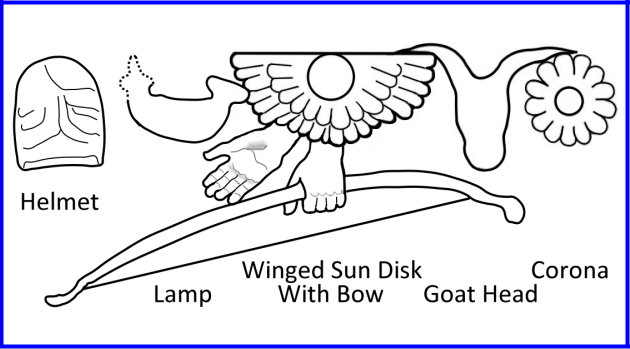
An example of an astronomical relief with an identifiable event is on the (BM 118898) “Broken Obelisk” of Aššur-bēl-kala (Assyrian King List #89). The drawing at the top of this post shows the portion of the relief with astronomical symbols. The sequence of events described in Aššur-bēl-kala’s royal inscriptions and other evidence places this monument in the first half of his second decade of rule. This astronomical relief matches a celestial event in one of those years. Chapter 5 of The Six Pillars (forthcoming) discusses the details that make identifying the king’s regnal year and the associated heavenly configuration definite.

Just as dated Babylonian kudurrus add substantially to the corpus of contemporaneous astronomical records, the abundance of extant Assyrian astronomical reliefs contributes significantly to proving the accuracy of the rectified timelines discussed in the book series The Astronomical Chronology. (The Six Pillars is Volume I.) They also demonstrate that the conventional chronology is seriously flawed, and the conventionalists’ claim that Assyrian reliefs do not depict celestial configurations is contrary to common sense and reality.