
Anciently recorded astronomical events greatly aid in reconstructing historical timelines, but only if they are unambiguous enough to be positively identifiable. One such record is a solar eclipse recorded in the Mari Eponym Chronicle (MEC). Immediately, it presents some problems because that record does not include the month of the observation. Nevertheless, the cuneiform fragment of the MEC with that detail gives us two crucial clues: 1) The previous year was the eponymy of “King Šamši-Adad’s birth,” and 2) the Assyrian eponym (or year name) associated with that birth was “Inaia.” Thus, the eponym “Inaia” might make it possible to identify this eclipse unambiguously.
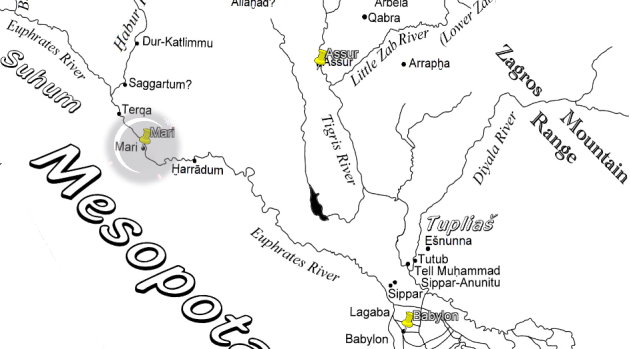
The Assyrians named each year in advance after their king or a high government official. The Babylonians and other Mesopotamian kingdoms named each year after an important event of the previous year. The minor city-state of Mari, located on a trade route parallel to the Euphrates River, did both. Since many Assyrian traders passed through their city, they used the Assyrian eponyms instead of choosing their own. However, those traveling merchants passed those year names to them orally, resulting in some spelling variations.
Scholars have compiled a list of these annual names for a period of more than 250 years, with no more than one or two missing. Only one, “Innaya,” is phonetically a precise match with “Inaia.” Still, that eponymy was during the reign of Puzur-Aššur II and was more than 60 years before Šamši-Adad I became king in Assyria. Since Šamši-Adad was the Assyrian monarch for 33 years and continued to fight battles until the end of his life, that eponymy is too early to be the year of his birth. However, “Inaia” could have been a misspelling of “Idnaya,” and the eponym list includes that name twice. The first was a century too early for the king’s literal birth, but the second coincided with the beginning of Šamši-Adad’s reign. Moreover, there was a high-magnitude solar eclipse over Mari around that time.
This evidence seemingly makes identifying the MEC eclipse very easy because “birth” in many languages can figuratively signify the start of something new, as in “our country’s birth.” So why do so many scholars try to assign “King Šamši-Adad’s birth” and the eclipse the following year to a date some four decades earlier when no eponym corresponded to “Inaia”? The reason is that one damaged MEC tablet shows that someone listed them there.
A common-sense approach leads to the theory that these events were from the early part of Šamši-Adad’s rule in Assyria, not this king’s literal birth. However, we must test both models’ historical accuracy with corroborating information.
Chapter 5 of The Six Pillars (forthcoming) tests the historicity of the “literal-birth model,” and it fails all three assessments. In contrast, the “figurative-birth model” is precisely compatible with the ‘standard’ Venus Tablets Middle Chronology. Moreover, ancient records include two other contemporaneously recorded astronomical events during the reign of Šamši-Adad. Although they are somewhat ambiguous, their associated eponyms are identifiable, and the interims between these events and their year names mesh perfectly with the solar eclipse and the eponymy of “Idnaya.” This combination results in the triple astronomical anchoring of Šamši-Adad I’s ruling period, which leaves no doubt about its accuracy. Furthermore, the restored Assyrian King List connects that absolutely dated reigning period with other astronomical events the Assyrians and Babylonians recorded centuries later. With this solution, all that remained was to explain how that erroneous cuneiform tablet came into existence, which Chapter 5 does.

This chronological puzzle was relatively easy to solve. Why has one flawed later effort at reconstructing the MEC fooled so many intelligent people? One reason is a lack of lateral thinking. Moreover, this post’s discussion reinforces that not all genuinely ancient records are of equal value. Millennia ago, people were interested in reconstructing their chronological histories, but they made many mistakes. We must take caution in accepting such records at face value.
The solution to the Mari Eponym Chronicle solar eclipse and “Šamši-Adad’s birth” involved using common sense, taking a step backward, and looking at the broader picture. The apparent answer soon became evident, and with further testing, it proved true.
6 comments