
Some researchers have attempted to extrapolate one of the chronological models of the Venus Tablets of Ammi-şaduqa backward in time to the twenty-fourth century BCE. However, the variables with unknown quantities could allow multiple fits between the models (High, Middle, Low, or Ultra-low Chronologies) and the hypothetical timelines of the Akkadian Empire. This fact raises the question, “How far back can we accurately extend these Venus-Tablet-based chronologies?” As explained in the last post, the Assyrian timeline, via the Venus Tablets Middle Chronology, is extendable back to the Assyrian calendar year of 1975/74 BCE. Is it possible to obtain this same precision with the Sumerian dynasties? Considering the timeline of the city-state of Isin illustrates both the problems and solutions associated with earlier periods.
Hammurabi conquered Larsa by the end of his 30th year as king of Babylon, i.e., in early 1762 BCE. His immediate predecessor in Larsa was Rim-Sin I, who had captured the city of Isin and become its king 31 years earlier, in 1793 BCE. Afterward, Rim-Sin ruled that town via his governor, Dadbanaya. From that point, we look backward in time to determine the length of Isin’s independence from the fall of the Third Dynasty of Ur until Rim-Sin’s rule.
Isin had 15 kings over approximately two centuries. Manuscripts of the Sumerian King List (SKL) record their sometimes-variant regnal periods. However, how accurate are those figures? Two classes of clues help us answer that question.
First: Year-names are extant for all these monarchs. If all the SKL copies agree on a ruling period, that datum is likely correct, especially if it equals the number of year-names. If those SKL versions have differing figures, but one agrees with the number of year-names, it is most likely the accurate value. The maximum and minimum sums of these 15 kingship periods, using the largest and smallest figures, are 240 and 222.5 years. In contrast, the total number of year-names is only 189, resulting in a half-century discrepancy between the extremes. Especially suspect is the ruling period of Damiq-Ilishu (the last king), preserved in only one version of the SKL, with a recorded reign of 23 years but with only 20 year-names. Also suspicious are the figures for Iddin-Dagan (#3), Ur-Ninurta (#6), and Bur-Suen (#7) due to the significant discrepancies between the SKL figures and the number of year-names, with differences of six, eleven, and eight years, respectively. (As it turns out, the minimal SKL figures are incorrect in only three instances, and one understates a ruling period.)
Second: Fortunately, astronomical data helps us determine the accurate values. Several of the year-names allude to celestial configurations. If these astronomical arrangements are reasonably consistent with each other, we can rectify some of the questionable figures. Moreover, the “Chronicle of Early Kings” records that Erra-imitti (#9) appointed a gardener, Enlil-bani, as a substitute king, implying a recent eclipse, possibly a solar one. Then, during the following three months, Erra-imitti died when he drank soup that was too hot, and Enlil-bani continued as Isin’s ruler. A once-in-multiple-centuries total eclipse occurred over Isin around that transition period, which can be no coincidence. Moreover, one version of the SKL gives Erra-imitti a reign of 7.5 years instead of 8, implying a mid-year event. This event identifies Erra-imitti’s final year and Enlil-bani’s first year as 1859 BCE.
Many of the astronomical allusions in year-names are ambiguous or obscure. Nevertheless, one is obvious. Šu-ilišu (#2) commemorated his making a boat for Ninurta as his ninth year-name (regarding his eighth). The celestial object associated with Ninurta is Saturn, and ‘the river of the sky’ is the Milky Way. Thus, this year-name strongly implies Saturn was about to enter the Milky Way, clearly identifying his eighth year as 1962 BCE.
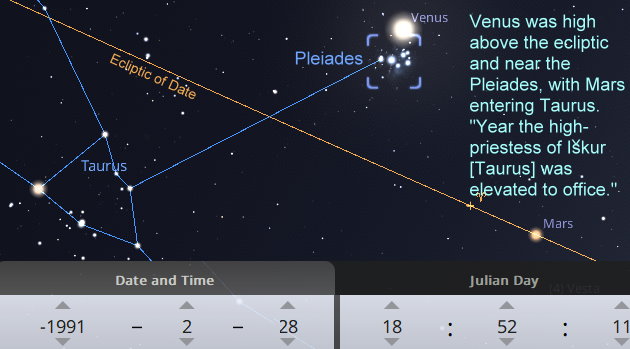
Išbi-Irra’s (#1) astronomical allusions were abundant but ambiguous. They mention Inanna (Venus), Ninurta (Saturn), Iškur (Taurus), and Ningal (the moon). The ancient Mesopotamians regarded specific locations in the sky as auspicious, and one such place was the Pleiades. Collectively, those year-names support the previous paragraph’s interpretation. The illustration above depicts one of his year-names. These events accurately place the first year of that dynasty in 2002 BCE.
With this process, we can make corrections to earlier parts of the Sumerian timeline, such as the Third Dynasty of Ur. Nevertheless, the accuracy of the SKL becomes even more questionable before then, and the number of astronomical clues becomes fewer.