
Humans learn by relating new things to facts we already know. We categorize and classify bits of information, which helps us to build our knowledge. History is the same. When studying ancient people, we want to know where and when events occurred.
Many students find history to be a boring subject. Yet, the clearer the picture of ancient events, the more appealing this subject becomes. The most challenging aspect of ancient history to determine accurately is often its chronology. If we know precisely when historical events occurred and how those happenings fit into national and international cultural contexts, history comes to life. Scientific knowledge is increasing the potential accuracy of dating ancient history. Radiocarbon dating and dendrochronology have significantly contributed to that understanding.
Archaeologists can often determine the sequence of ancient events, the relative ages of archaeological strata and the related artifacts. Still, they sometimes do not know how long a particular period of history lasted. If they do, they know the relative chronology, a step up from just knowing the sequence or order of archaeological strata. However, the ideal precision we can strive for in this aspect of history is absolute chronology, which means we can assign specific events to exact dates in the Julian calendar, i.e., years BCE. If reliable king list data exists, we can often date an event within decades or a few years of precision and sometimes precisely to a specific year.
Scientists have done genetic studies on nations and tribal groups worldwide, and people can now get their DNA analyzed, often telling them where their ancestors originated. When their ancestry proves to be a mix of ancient tribal groups, they might wonder why. Did those ancestral groups voluntarily associate with each other, or was it a result of one nation attacking another and partially assimilating it? To what extent did the perverse glorification of warfare cause such conflicts? Or did climate events cause food shortages and difficult living conditions, leading to forced migrations and food raids?
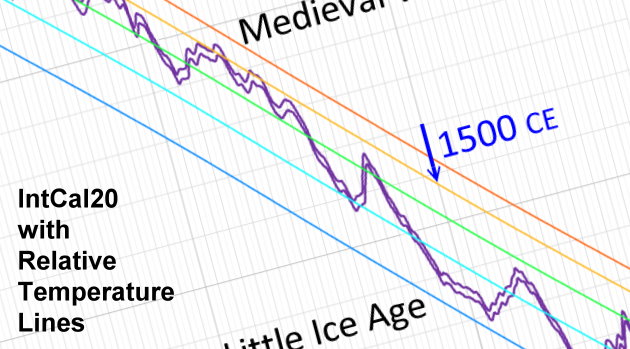
Chronology, combined with details from ancient inscriptions, can help us understand the answers to these questions. Determining the absolute chronology of those events can help us appreciate the causes. Radiocarbon-dated samples of ancient organic materials typically have decades-long error ranges and are, therefore, not precisely datable. Nevertheless, the most recent iteration of the Northern Hemisphere Radiocarbon International Calibration Curve, IntCal20, has a yearly resolution for the last five millennia. Its “wiggles” reflect relative warmth conditions. (See the forthcoming “The Radiocarbon International Calibration Curve as a Temperature Gauge Proxy for the Historical Timeline.” See also the illustration above.) The Anatolian-based Aegean Dendrochronology Master Index provides annual data about precipitation levels. (Chapter 3 of The Six Pillars astronomically anchors this index.) This combination offers relatively accurate pictures of climate conditions in the ancient Middle East in the second millennium BCE, thus contributing more details about ancient history and helping us to understand the likely motives for many ancient conflicts.

Although these two scientific techniques can provide annual resolution, we can align the contemporaneous historical data with it only if we have absolute timelines. Achieving this degree of precision is a worthy goal, yet it is possible only with astronomical anchoring.
Accurate ancient chronology makes history more exciting and improves our comprehension of past events and their causes. It is another tool in the toolbox of historical analysis that contributes significantly to the clarity and accuracy of our knowledge.
(See an excellent summary of this topic with further points from Terry Haydn.)