
The sun dimmed. Frost occurred in July. Heavy rainfall toppled temples and buildings. Hot and cold weather arrived in disorder. The five cereal crops withered and died. —Troubled Times during Jié’s Reign
(Modified 7 May 2025) The combination of scientific data and internal clues from Egyptian chronology and history fix the eruption date of Thera to 10 September 1650 BCE. As in the Tambora eruption of 1815 CE, the worldwide effects began occurring the following year (1649), and they affected China as well. As NASA scientists reported in 1989, the climate effects recorded in Chinese documents included the dimming of the sun resulting in frost in July, the failure of all five cereal crops, and heavy flooding. These things occurred during the transition period between the first two major Chinese dynasties, the Xià (夏朝 Xiàcháo) and Shāng (商朝 Shāngcháo). The final emperor of the Xià Dynasty was Jié (桀), and he lost control of China to the first emperor of Shāng, Chéng Tāng (成湯).
Scholar Shan Ling 凌山 has also identified 1649 BCE as a crucial date in that transition period based solely on Chinese historical data. Is that dated event relatable to the Thera eruption? Some of the history of that period is slightly confused due to historians compiling that information much later. However, the following puzzle pieces fit together convincingly:
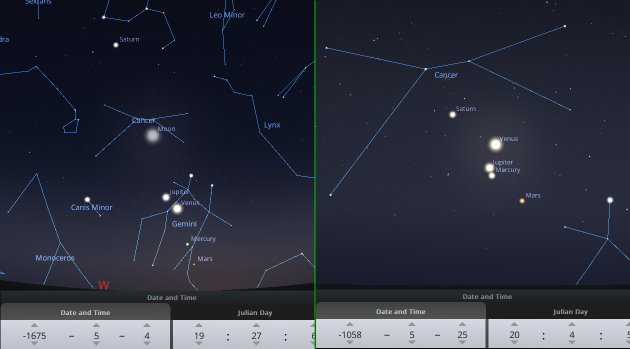
Wǔ (武) was the first monarch of the subsequent dynasty, Zhōu (周). He defeated the last emperor of Shāng, Zǐ Shòu 子受 (a.k.a. Dì Xīn 帝辛). Using multiple astronomical clues, the Xia-Shang-Zhou Chronology Project verified that this conquest began on 20 January 1046 BCE, resulting in the Battle of Muye and the end of the Shāng Dynasty. It was likely some 13 years earlier that King Wǔ witnessed a tight grouping of all five visible planets in Cancer, illustrated above. Many of the Chinese believed this was a Mandate of Heaven (天命 Tiānmìng, “God’s command”) that a new empire replace the corrupted Shāng Dynasty.
Shan Ling commented that author Liú Xīn 劉歆 [early first century CE] recorded the length of the Shāng Dynasty as 629 years. If correct, that span would place King Chéng Tāng’s accession in 1676/75 BCE. Some believe that early in his rule as a vassal or duke, he also observed the five planets were simultaneously visible, likely around 4 May 1676 (or possibly 14 September 1674). Based on this apparent Mandate of Heaven, he obtained support from other dukes to overthrow Emperor Jié of the Xià Dynasty.
Shan Ling wrote that Chinese records show an unusual event occurred in Chéng Tāng’s final year: chronicles of the sexagenary cycle of days (60 sets of two-character names that continuously repeat) showed that an astronomical dark moon coincided with a winter solstice, and it was the first day in the 60-day cycle, jiǎzǐ (甲子). Even allowing for plus or minus two days of error for the solstice date, this triple combination (甲子朔旦冬至 jiǎzǐ shuò dōngzhì) can occur only once in 354 years. Therefore, Shan Ling identified this event’s only possible date as 5 January 1649 BCE (though technically, it was day 60, guǐhài 癸亥, one day before jiǎzǐ).
The Bamboo Annals state that Chéng Tāng became emperor in his 18th year as a vassal king and died after reigning 29 years. The record regarding the triple combination is in The Book of Han, Volume 21, “Treatise on Rhythm and the Calendar” (漢書·律曆志下). It stated, “When Chéng Tāng was approaching his 13th year as emperor, in the 11th month, 甲子 occurred on the dark moon/winter solstice.” The Bamboo Annals also say that “three suns appeared together” in the 29th year of Jié of Xià, describing a possible effect of the Thera eruption. This detail concerns a sun dog, which can happen only when ice crystals are in the atmosphere and can occur during the “volcanic winter” following a severe eruption. This triple sun possibly appeared in the winter of 1650/49 BCE. Perhaps a later compiler transposed this detail from Chéng Tāng’s 29th-year record to Jié’s.
These details imply that the winter solstice, dark moon, and jiǎzǐ that were in January 1649 at the end of Chéng Tāng’s 12th year were also during his 29th year as king. If these deductions are correct, his first regnal year as a vassal king began in 1678 BCE, and the Shāng Dynasty began in 1662 BCE, with Chéng Tāng’s first official year in 1661. Thus, the Thera eruption’s absolute date helps to establish some pivotal points in Chinese chronology.
One comment